Details
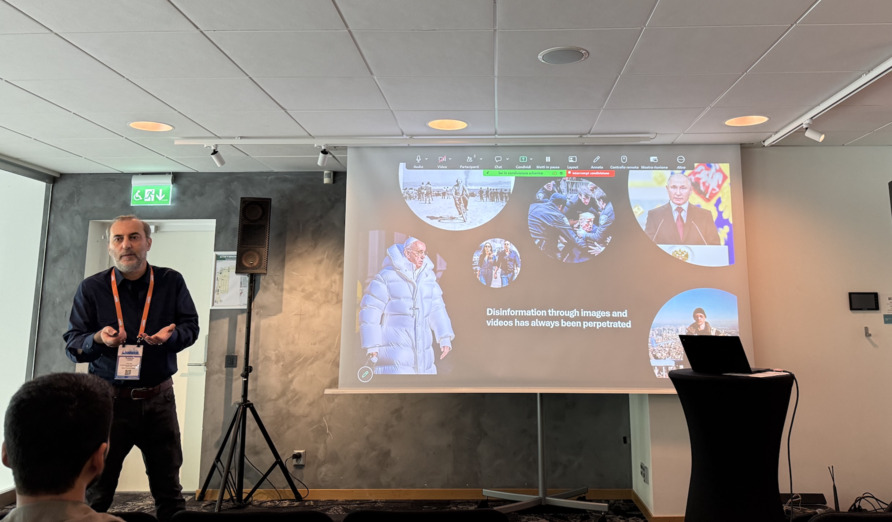
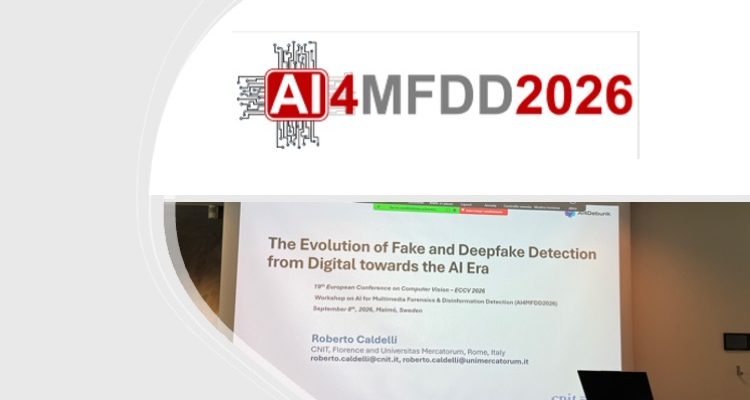
On September 8, 2026, Roberto Caldelli, affiliated with Universitas Mercatorum (Rome), CNIT (Florence), and the Media Integration and Communication Center (MICC), Department of Information Engineering (DINFO), University of Florence, delivered a keynote at the third edition of the workshop AI for Multimedia Forensics & Disinformation Detection (AI4MFDD 2026), held in Malmö, Sweden, as part of ECCV 2026.
The keynote, titled “The Evolution of Fake and Deepfake Detection from Digital towards the AI Era,” explored the evolution of fake and deepfake detection in the era of generative AI, focusing on the challenges posed by increasingly sophisticated AI-generated media to traditional forensic approaches. It also addressed current challenges in deepfake detection and relevant considerations in the context of the EU AI Act.
The presented work is also connected to the latest studies and research activities conducted within the European AI4DEBUNK project, funded by the European Union through the Horizon Europe Programme.
Abstract
Digital media manipulation has evolved from localized pixel editing into a complex, algorithm-driven challenge powered by generative AI. This keynote provides a deep technical exploration of how fake detection has adapted to this shift, charting the evolution of detection methodologies from traditional statistical heuristics to advanced deep learning architectures. The talk will analyze how the concept of fake detection has evolved through time from classic digital forensics, which relied on detecting hand-crafted artifacts, to the current AI-dominated landscape. As Generative Adversarial Networks (GANs) and Diffusion Models eliminated these traditional traces, detection paradigms had to pivot. The session will try to understand how old clues can still be used for detection and how previous concepts can be applied yet. In order to redefine new opportunities for detection methods, the definition of what is “real” nowadays will be dissected. Finally, the keynote will address the core technical bottlenecks facing current detectors, including generalization gaps across unseen generative models and robustness in real-world applications; considerations and open issues for deepfake detection, also with respect to the EU AI Act, will be provided.