Details
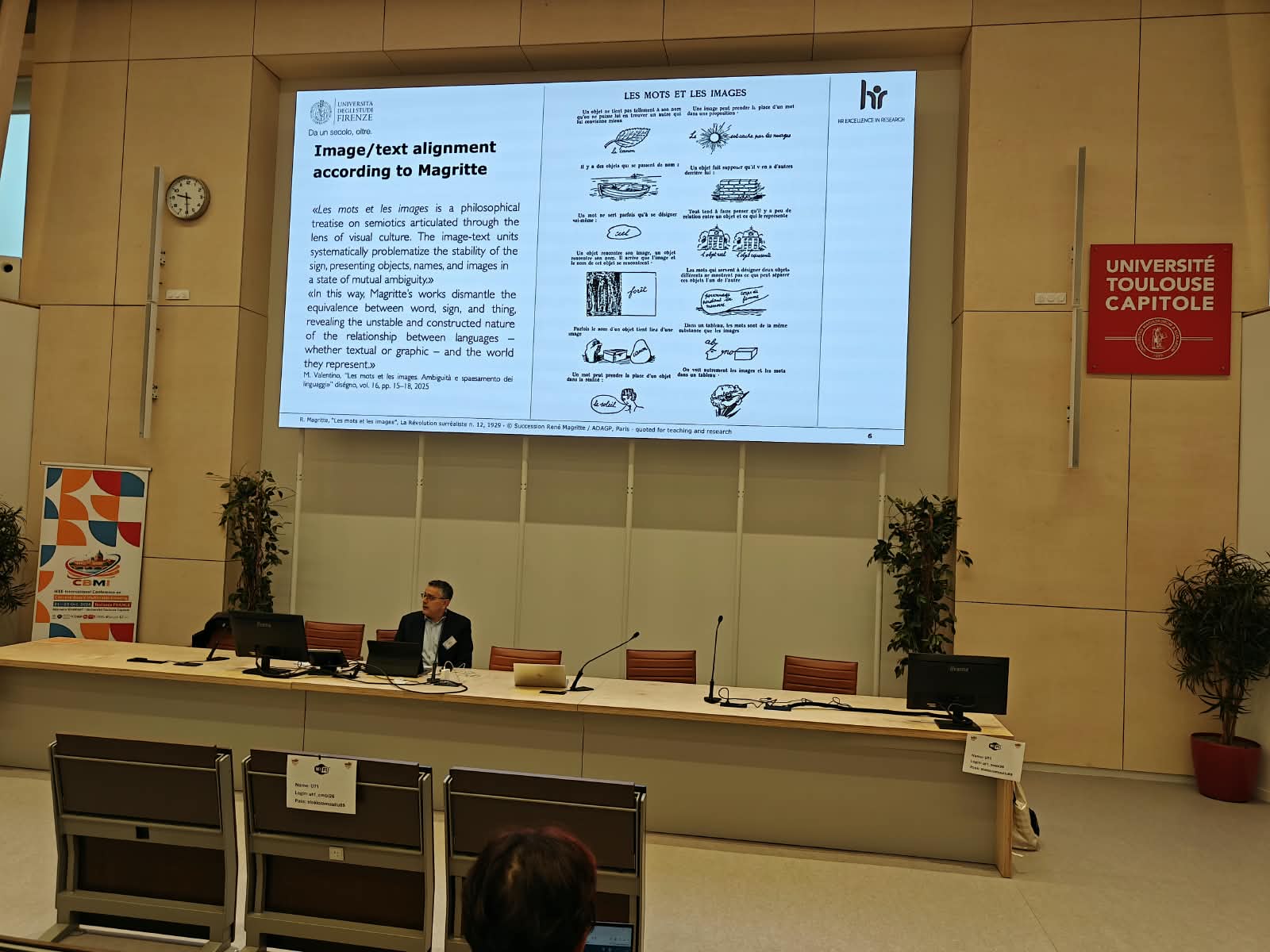
From October 21 to 23, 2026, Marco Bertini, Director of the Media Integration and Communication Center (MICC), Department of Information Engineering (DINFO), University of Florence, delivered a keynote at CBMI2026 the 2026 IEEE International Conference on Content-Based Multimedia Indexing (IEEE CBMI 2026) in Toulouse, France.
The keynote, entitled “Image-Text Alignment: from Composed Image Retrieval to Image Quality Assessment,” explored image-text alignment in vision-language models through two complementary tasks: composed image retrieval, which combines a reference image with a textual description to express desired changes, and image quality assessment, which focuses on perceptual properties such as sharpness, noise and compression.
Abstract
Vision-language models have made natural language a default way to search multimedia content, realizing a goal the multimedia community has pursued since it first confronted the semantic gap between what users want to say and what systems can compute. Today we search, edit and even judge images simply by describing what we want. The alignment that makes this possible, learned contrastively by models such as CLIP, is not neutral. It is semantic by construction and only weakly sensitive to how an image looks, and it is shaped by a modality gap that makes even image-to-image comparisons less reliable than we tend to assume. This talk examines image-text alignment through two tasks that stress it in opposite directions. Composed Image Retrieval needs alignment to be compositional: a reference image and a relative caption must become a single query that says what should change and what must stay. Image Quality Assessment, by contrast, needs it to be perceptual. Images with the same content must be ranked by sharpness, noise or compression, exactly the attributes that semantic pre-training learns to discard. Our work on both problems shows that they have followed the same path. On the retrieval side, it concerns how composed queries are represented, from fine-tuning and fusing CLIP features in the supervised setting to moving the reference image into the textual space for zero-shot retrieval, through textual inversion and text-oriented image query representations. It also includes modality inversion for diagnosing intra-modal misalignment. On the quality side, it spans language-based quality evaluation and quality-aware image-text alignment for opinion-unaware IQA. Both fields started from supervised models trained on costly annotations (triplets in one case, mean opinion scores in the other). Both escaped this bottleneck through self-supervision, and both are now being reshaped by multimodal LLMs that reason before they retrieve or score.
IEEE CBMI 2026 – Conference Website